Structural Strength and Durability of Pre-Engineered Steel Buildings
- utkarshindia87
- Sep 12, 2025
- 3 min read
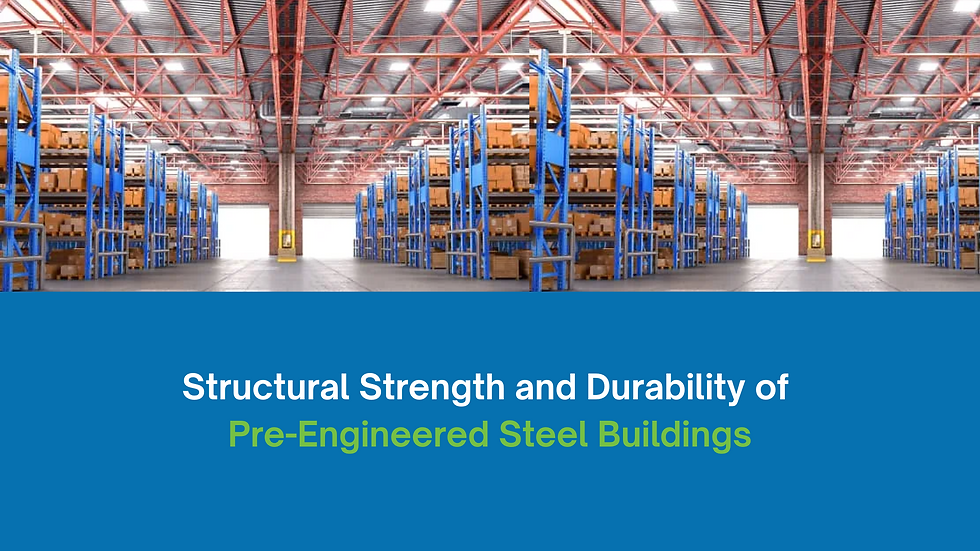
As a practising structural engineer speaking to a peer in an infrastructure engineering company, I’ll be direct: when you need speed, repeatability, and proven longevity, pre engineered steel buildings deserve a top‑ranked place on your shortlist. This piece is written as a practical briefing — with questions, bullets, a compact table, and a procurement checklist — so your team can act on it quickly.
Why Choose Pre-engineered Solutions?
Faster delivery — factory fabrication compresses schedules.
Predictable costing — bills of materials and shop drawings reduce surprises.
Repeatable quality — manufacturing tolerances beat site variability.
Question for you: how often do project delays cost more than the structure itself? If the answer is "too often," pre-engineered solutions reduce that exposure.
Factory Precision and the Assembly Advantage
Components manufactured to millimetre tolerances.
No on-site cutting for primary members: less waste, fewer safety incidents.
On-site assembly is like modular furniture at scale — engineered fit, rapid erection.
Structural Strength: Engineered for Load
When we talk about structural capacity, we want three guarantees: load path clarity, redundancy, and connection reliability. Pre engineered steel buildings are engineered from first principles to provide them.
High Load-Bearing Members
Section selection is optimized for bending, shear, and axial demands.
I‑sections, box sections, and tapered members are chosen to meet machine loads, crane rails, and storage racks.
Result: higher usable clear spans compared with conventional masonry or timber structures.
Connections and Moment Resistance
Connection Type | Best Use | Notes |
Bolted flange plates | Primary frames | Controlled pre-tensioning improves fatigue life |
Welded moment connections | Heavy crane rails | Shop-welded improves on-site quality control |
Shear tab bolted | Purlin/rafter joins | Fast erection, easy replacement |
Ask your design team: are the connection details sealed in shop drawings? If yes, you’re mitigating a large portion of the erection‑stage risk.
Durability Factors that Matter
Durability isn’t a single attribute — it’s a system outcome. Steel building durability depends on coating systems, detailing, thermal cycles, and maintenance strategy.
Corrosion Protection and Maintenance
Hot-dip galvanizing plus shop primer is a standard for outdoor frames.
Localized sacrificial coatings at cut edges and bolt holes reduce corrosion cells.
A simple maintenance schedule (visual inspections every 12 months, touch-up painting every 5–8 years) prolongs service life substantially.
Thermal Performance and Fatigue Life
Thermal movement and cyclic loading are often overlooked. For industrial environments with temperature swings or vibrating equipment:
Design for expansion joints and slotted connections where necessary.
Specify fatigue‑resistant details for crane runways and repetitive point loads.
Applications and Case Examples
Where do pre engineered metal buildings and industrial steel buildings perform best? Typical applications across our customer groups include:
Warehouses and logistics hubs — long clear spans, quick turnarounds.
Substations and switchgear housings for power sector clients — precise fit and weather protection.
Government and defence depots (BRO, PWD projects) — repeatable standards, approved shop drawings.
Government & Power Sector Use-Cases
Power utilities (transmission and distribution) often prefer pre-engineered solutions for:
Switchyard buildings with tight delivery schedules.
Modular workshop units that can be relocated.
Storage for sensitive equipment where environmental control matters.
These are classic situations where pre engineered metal buildings out-perform bespoke masonry in both schedule and whole-life cost.
Quick Checklist for Procurement Teams
Verify manufacturer certification and fabrication tolerances.
Request sample shop drawings and FAT (factory acceptance test) photos.
Confirm coating systems and warranty terms for steel building durability.
Ensure tender includes clear erection methodology and QA hold points.
Include a 10‑year maintenance cost model in the procurement evaluation.
Interactive prompt — a practical scenario
Consider this: a 30 m clear-span warehouse for storing transformer spares. Faster commissioning saves the client 60 days of logistics downtime. Would you accept a 5% premium for a pre-engineered solution that shaves 60 days off the schedule? Most procurement specialists say yes — because 60 days of critical spares shortage is a high-risk exposure.
Conclusion — a Practical Recommendation
To summarise: industrial steel buildings bring repeatability, superior load performance, and measurable life‑cycle benefits. For your government, infrastructure, and power sector clients, they reduce schedule risk and total cost of ownership. If your next tender involves large clear‑span requirements, heavy equipment, or time‑sensitive delivery, start by asking bidders for detailed shop drawings, protective coating specs, and a defined maintenance plan.


Comments