Advantages of Using Electric Resistance Welded Pipes Over Seamless Pipes
- utkarshindia87
- Oct 12, 2025
- 3 min read
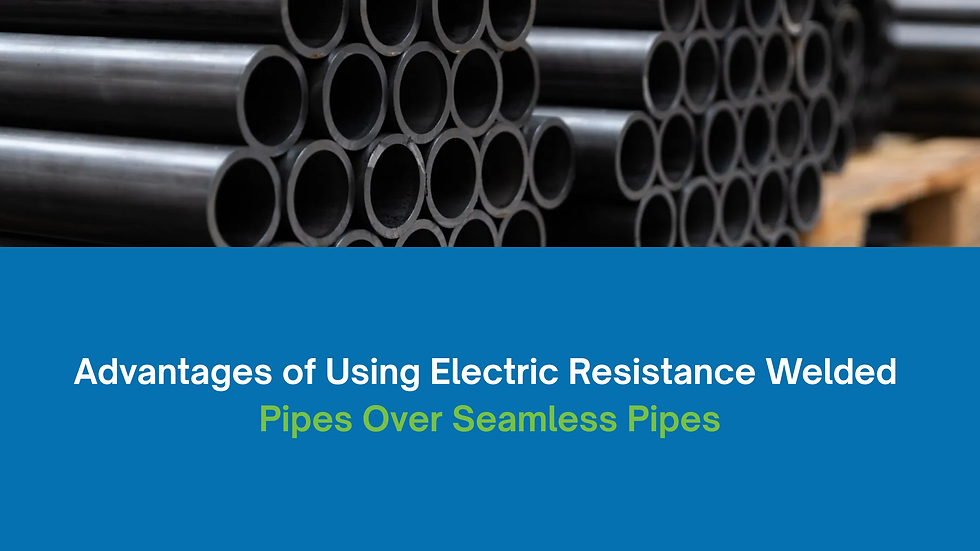
Think of this as a quick briefing over a cup of tea. Which pipe do you specify when budgets, timelines, and long-term performance all matter? For many projects, electric resistance welded pipe (ERW) delivers the sweet spot between cost, availability, and reliability. We’ll walk through the why — with questions to make you think like an engineer and a buyer.
What is an Electric Resistance Welded Pipe?
An electric resistance welded pipe is produced by forming a steel strip into a cylindrical shape and welding the long seam using electrical resistance. The method gives consistent wall thickness, high dimensional accuracy, and repeatable mechanical properties — especially when followed by modern post-weld heat treatments.
What are Seamless Pipes?
Seamless pipes are forged from a solid billet and pierced to create a hollow section — no weld seam. They’re excellent where extremely high pressure or temperature requirements rule, but their production is heavier, costlier, and sometimes slower to deliver.
Why ERW Pipes Win on Cost and Lead Time
Lower production costs: ERW process uses strip/coil feedstock and continuous welding — less machining and scrap.
Faster delivery: continuous mills produce long lengths quickly; great when schedules are tight.
Better availability: ERW pipes are stocked broadly by suppliers and distributors, so project procurement is simpler.
Question for you: On your last tender, how much did procurement delays cost the project? If lead time matters, ERW often reduces risk.
Manufacturing Differences (Numbered steps)
Coil is unwound → 2. Formed into a tube → 3. Seam welded by resistance → 4. Sizing and straightening → 5. (Optional) heat treatment/coating.
By contrast, seamless requires billet heating → piercing → elongating → multiple heat/roll cycles.
Quality Control and Dimensional Consistency
ERW pipes now achieve tight tolerances: diameter, ovality, and wall thickness are controlled throughout production. That translates to predictable fit-up on-site and less rework — a real cost and time saver for civil and structural teams.
Technical Advantages: Strength, Durability, Corrosion Resistance
Welding Integrity and Metallurgy
Modern ERW welding equipment and inline NDT (non‑destructive testing) reduce seam defects dramatically. With proper process control, the welded seam exhibits metallurgical continuity comparable to the parent metal — meaning structural integrity is excellent for most infrastructure uses.
Coating and Corrosion Protection
ERW pipes accept coatings and galvanizing uniformly. For water distribution, fencing, scaffolding, and many pipeline services, a coated ERW pipe provides long service life with predictable maintenance cycles.
Analogy: If a seamless is a handcrafted watch, ERW is the high-quality Swiss-made assembly line watch — both keep time, but one scales reliably for the masses.
Applications and Industry Fit
Infrastructure & Construction Use Cases
Structural columns, railings, scaffolding
Water mains and drainage
Signposts and street furniture
Power Sector and Energy Applications
Cable conduits, HVAC ducting, and low-to-medium pressure pipelines
Utility frameworks where predictability and cost control are priorities
Question: For your next transmission or substation project, where do you prioritize cost vs. maximum pressure rating?
Quick Decision Table and Final Recommendations
Criteria | ERW pipes | Seamless pipes |
Cost | Lower | Higher |
Lead time | Shorter | Longer |
Dimensional consistency | Excellent | Good |
High-pressure extreme service | Limited | Superior |
Ease of procurement | High | Moderate |
Final Recommendations
Choose ERW pipes when you need cost-effective, consistent, and widely available pipe for infrastructure, construction, and many utility applications. (Remember the keyword: ERW pipes.)
Reserve seamless for extreme-pressure, high-temperature, or specialty metallurgy applications.
When specifying, include NDT and coating requirements to lock in performance.
ERW pipe advantages are not marketing fluff — they are practical benefits: cost savings, speed, and consistent quality. When comparing ERW vs seamless pipes, think of the application first. If the service conditions are within ERW’s design envelope, you’ll often get better total value and lower procurement risk.
Comments